When will the AI bubble pop?
Early warning signs, an AI experiment, and some big decisions.
11 min read
Available on GitHub
You've heard this before: “we're in an AI market bubble”. Billionaires and academic papers claim this. I'm not going to verify if we are in one. I'll assume we are, and that investors and business leaders would very much like to know when the bubble might pop — preferably early enough to reconsider their investments before the market reacts and business conditions change significantly.
That's the tricky part, though. No one can tell the future. I can't either, don't be fooled. But I think there could be an interesting early-warning signal, a simple technical solution to tracking it, and a plan for what to do if the warning signs appear — bear with me.
Follow the Money
When people discuss the AI boom, they tend to focus on the most visible companies: frontier AI labs (OpenAI, Anthropic, Mistral AI, DeepSeek and others), hyperscalers (Microsoft, Google, Amazon), and the companies supplying the necessary computing hardware (Nvidia, AMD and others). If any of those companies claim lower AI revenue or announce reduced investment in AI infrastructure, then we'd have our signal “straight from the horse's mouth”. In fact, as I write this, reports have emerged questioning previously publicised figures for OpenAI's revenue. It's worth noting that this is a single frontier lab that could be independently losing clients to others, so this by itself is not “the signal” I would be looking for.
However, very often we're not so lucky and need to track events affecting a company's supply chain to try to anticipate those announcements.
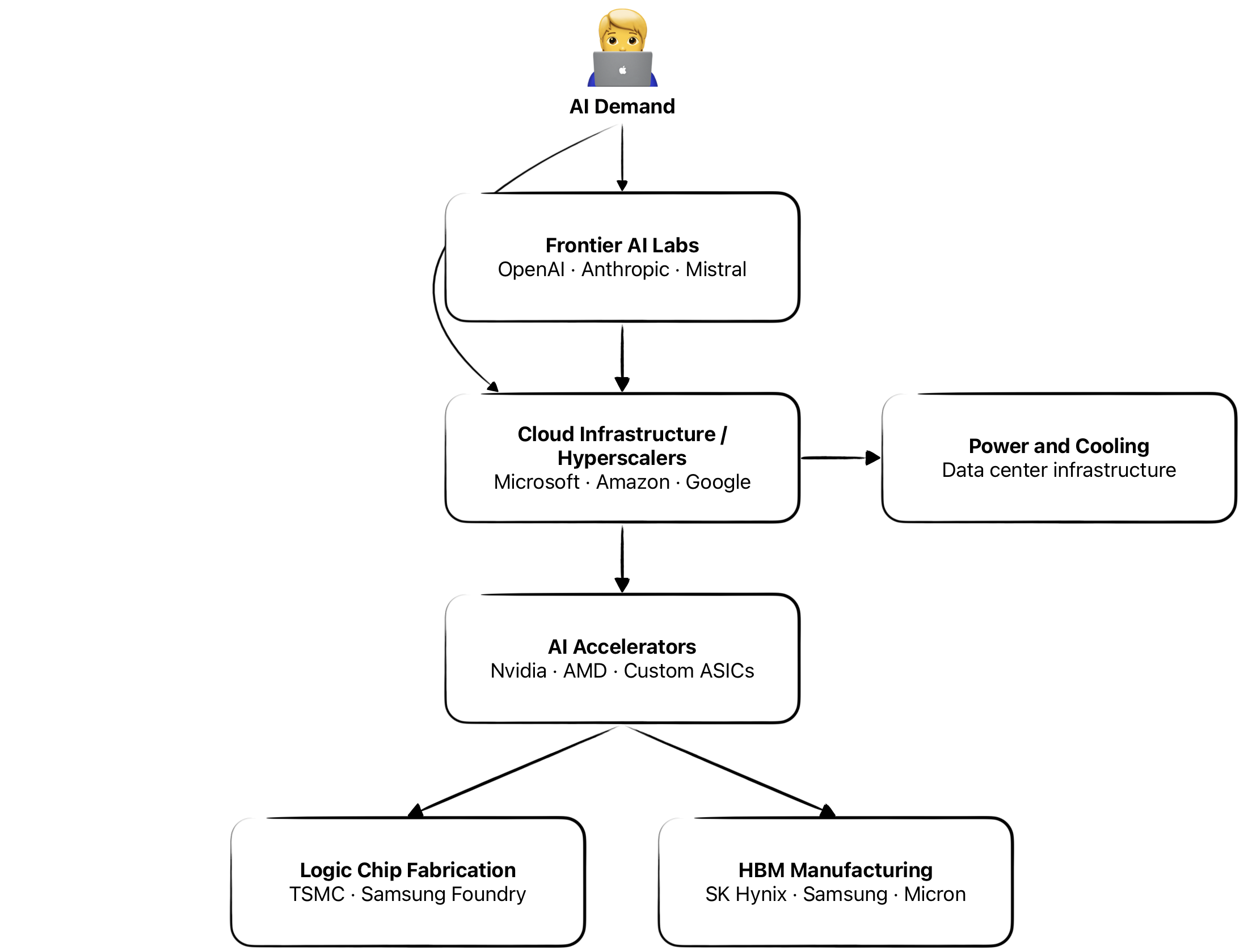
AI demand fluctuates over the year, but the remaining elements on the chain take years to develop or increase capacity. Constructing and equipping a modern semiconductor fabrication plant — a fab — can cost billions. Such investments require confidence that future demand will justify the expense. Changes in investment decisions along this chain may therefore reveal changes in expectations about future AI infrastructure demand — potentially before those changes become apparent in the revenues of frontier AI labs.
What part of the investment chain should we look at, though?
The Canary in the Coal Mine
If multiple frontier AI labs privately cut down on datacenter development, their orders for AI chips will be reduced, so we could look at the orders Nvidia has for its chips. However, Nvidia isn't the only supplier of AI accelerators. Hyperscalers and frontier AI labs are increasingly developing custom chips, so declining Nvidia orders might reflect changes in market share rather than declining AI infrastructure demand.
We could move slightly further upstream. Everyone tends to ask the same pure-play foundries (TSMC et al.) to manufacture their AI chips. However TSMC also manufactures many other chips (car chips, aircraft chips, etc.), making TSMC's aggregate orders a less specific signal for my purposes.
“Chips” is too broad a term here. What is meant is usually the processing units (GPU, NPU) that perform the necessary computation (e.g., inference) themselves. To compute they need extremely fast memory. For many LLM workloads, particularly inference, memory bandwidth is a major performance bottleneck. That's where high-bandwidth memory (HBM) comes in. The HBM market is dominated by just three manufacturers: SK Hynix, Samsung and Micron. All of them (and smaller players) have announced plans for the construction of new memory fabs in the last couple of years.
This is an industry with painful memories of overinvestment. In previous cycles, manufacturers expanded production capacity in anticipation of growing demand, only to face falling memory prices and substantial financial losses. Some didn't survive: Qimonda went bankrupt in 2009, followed by Elpida in 2012. Micron subsequently acquired Elpida. SK Hynix, Samsung and Micron have good reasons to avoid repeating those mistakes. If expectations of future AI demand begin to deteriorate, changes to their investment plans could provide valuable warning signals. Other manufacturers, such as Kioxia, SanDisk, CXMT and Nanya, could provide additional evidence of a broader industry trend, although their exposure to AI demand varies considerably.
My hypothesis is straightforward:
If several major memory manufacturers independently begin postponing, reducing or cancelling planned investments, that could indicate weakening confidence in future demand for AI infrastructure.
I'm particularly interested in changes of direction:
- Announced capacity expansions becoming postponements.
- Previously increased capital expenditure being revised downwards.
- New fabs being delayed or cancelled.
- Manufacturers explicitly citing weaker demand or customer commitments.
None of these events proves an AI bubble is bursting. And there are also important counterarguments. Advances in memory technology might reduce the need for certain investments. Existing fabs might become more productive. The memory industry is notoriously cyclical, independently of AI. NAND and conventional DRAM follow market dynamics that aren't identical to HBM. The frontier AI labs themselves may announce downscaling plans.
For that reason, I'd treat these developments as signals to investigate, not conclusions to accept.
Since my usual news feeds don't cover these companies in sufficient detail, how can I spot these developments without drowning in irrelevant news?
Who's Watching the Canary?
If I had a team of analysts, I could ask them: “track this and let me know as soon as it happens”. Since I don't, I decided to build a small AI-powered system to do it for me. It's a practical example of how AI can augment an individual's productivity.
There are plenty of apps that monitor news sources using keyword-based rules — like when “this and that word is present”. That won't work for my case. What I need is a system that can read and understand the news to make a decision on what the news is about. I need an LLM to read the news.
I wanted a simple system that would continually scan financial news, identify developments relevant to my hypothesis and notify me when something interesting happened. I also wanted to experiment with n8n, an open-source-oriented workflow automation platform that has attracted considerable attention through its AI integrations.
The result was a small news-monitoring workflow.
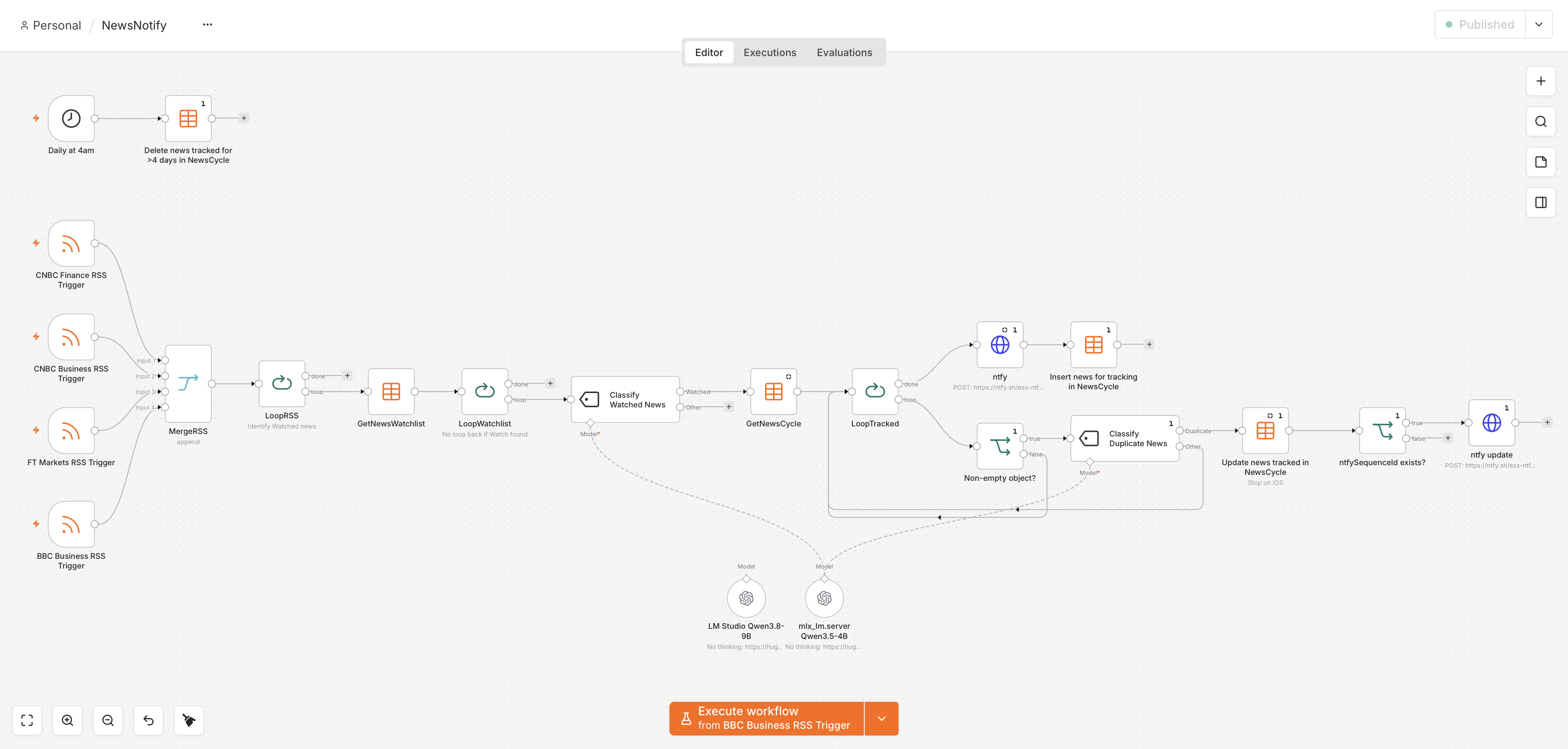
As a bonus, I added deduplication capability. News outlets often report the same event using different headlines and descriptions. A second LLM classification determines whether an incoming article describes an event already reported, grouping related stories into a single notification rather than repeatedly alerting me about the same thing.
I won't turn this into a technical tutorial, though. The workflow is simple enough to follow, and I've published the complete n8n workflow on GitHub for anyone interested.
There are certainly other ways to build this, from a few Python scripts to commercial news intelligence services. I chose n8n because I wanted to experiment with its AI capabilities and have plans to expand the workflow further.
And you know what? This entire system runs on an old M1 MacBook Pro with just 16 GB of unified memory. As I demonstrated in my previous article on local AI, you don't need a €10,000 computer to run useful AI workloads. My n8n workflow uses a locally hosted Qwen 3.5 4B model, running through MLX with thinking disabled. Classifying a news item takes just 2–5 seconds. Not bad for a 6-year-old MacBook!
For now, this is a monitoring experiment, not a validated financial intelligence system.
Now What?
Let's assume my system starts detecting several memory manufacturers postponing major fab investments. What should I do with that information?
First, nothing drastic.
A signal isn't a decision. It's a reason to investigate. I'd first want to understand whether manufacturers are responding to a shared reduction in expected AI demand or to unrelated circumstances. Then I'd look for corroborating evidence: declining accelerator orders, reduced hyperscaler capital expenditure, falling HBM prices, or weakening AI infrastructure utilisation.
Suppose the evidence increasingly points in the same direction: weakening demand. What decisions might that influence?
As an investor, I'd reassess my exposure to companies whose valuations depend heavily on continued AI infrastructure expansion. That doesn't necessarily mean selling anything. It means reconsidering whether the assumptions behind an investment remain valid.
As a business leader, I'd assess my exposure to AI providers that could face financial difficulties. If a cloud provider or an LLM supplier fails, how would that affect my services? Do I have viable alternatives? I'd also consider the commercial implications: if customers become sceptical of AI-based products following a market correction, how much could that affect our sales? Should we reconsider how we position and market our products?
As a technology entrepreneur, I'd reassess the risks I knowingly accepted when starting my business. Perhaps I anticipated an AI market correction but judged the potential rewards worth the risk. Now that warning signals are appearing, have I built a sufficiently strong competitive moat or accumulated enough financial reserves to weather a downturn? If not, is the potential reward still worth the exposure, or should I consider pivoting — perhaps even winding down the business and pursuing Plan B?
There's also a distinction worth making: the AI investment boom could slow down without AI adoption slowing down. Lower infrastructure costs, more efficient models and greater competition could accelerate adoption even as returns for some infrastructure investors deteriorate. A market correction isn't necessarily a technological failure.
My little monitoring system won't tell me when the AI bubble will burst. What it might do is alert me to changes in the assumptions supporting the industry's investment decisions, prompting me to investigate before making decisions of my own.
That's not predicting the future. It's preparing for it.